
How I analyse a football match before I put a bet on it
There is no secret system and no little machine under my desk that flashes green when there is a winner. There is research, numbers, experience, common sense and a fairly unhealthy amount of tea.


I've got a confession. I don't actually know who's going to win.
There. That's probably not the opening you were expecting from a football tips website. But it's true. Neither does anyone else. Not with any certainty, anyway.
I've watched enough football over the years to know that the minute somebody tells you they've worked out exactly what's going to happen in a football match, you should probably take a step backwards. Football has a habit of making clever people look very stupid.
I've seen teams dominate for 90 minutes and lose. I've seen teams play terribly and win. I've seen goalkeepers produce the performance of their lives. I've seen defenders forget what they're doing. I've seen a striker score with his backside.
And I've watched Bristol City.
So I'm under no illusions about my ability to predict the future. What I can do is analyse a match. And over the years, I've developed a way of doing that.
It isn't a secret system. There isn't a little machine under my desk that flashes green when there's a winner. It's mostly research, numbers, experience, common sense and a fairly unhealthy amount of tea.
And sometimes, after all that, I decide there isn't a bet worth taking. That last part is more important than people realise.
First things first - I look at the match itself
This sounds obvious. It isn't always.
One of the easiest mistakes to make when looking at football betting is starting with the question: "Who do I think will win?" I try not to do that. Instead, I start by asking: "What sort of match is this likely to be?"
Who's playing? Where are they playing? What's at stake? What sort of football do these teams normally play? Are we looking at two sides who are likely to cancel each other out? Are we looking at a strong home side against a team that struggles away?
Is one team desperate for points? Is the other already on the beach? Has there been a managerial change? Are there injuries that could completely alter the way one side plays?
Before I start looking at prices, I want to understand the game. Otherwise you're just staring at numbers. And numbers, lovely though they are, don't kick the ball.
Then I look at the recent form
This is where things can get dangerous. Everybody loves form.
Five wins from six. Four defeats in a row. Seven consecutive games without a clean sheet. It all looks very neat. Football tables are basically catnip for people who like patterns.
But recent form can be incredibly misleading. Let's say a team has won its last four matches. Sounds good. But who did they play? If those four wins came against the teams sitting 18th, 19th, 20th and 21st, I'm not going to suddenly decide they're Barcelona.
Likewise, a team might have lost three of their last four but have played three of the best sides in the league. The results tell you something. They don't necessarily tell you everything.
So I look at the results, but I also look behind them. How did they perform? How many chances did they create? How many did they concede? Were they actually playing well, or did they just happen to get the results? That's an important distinction.
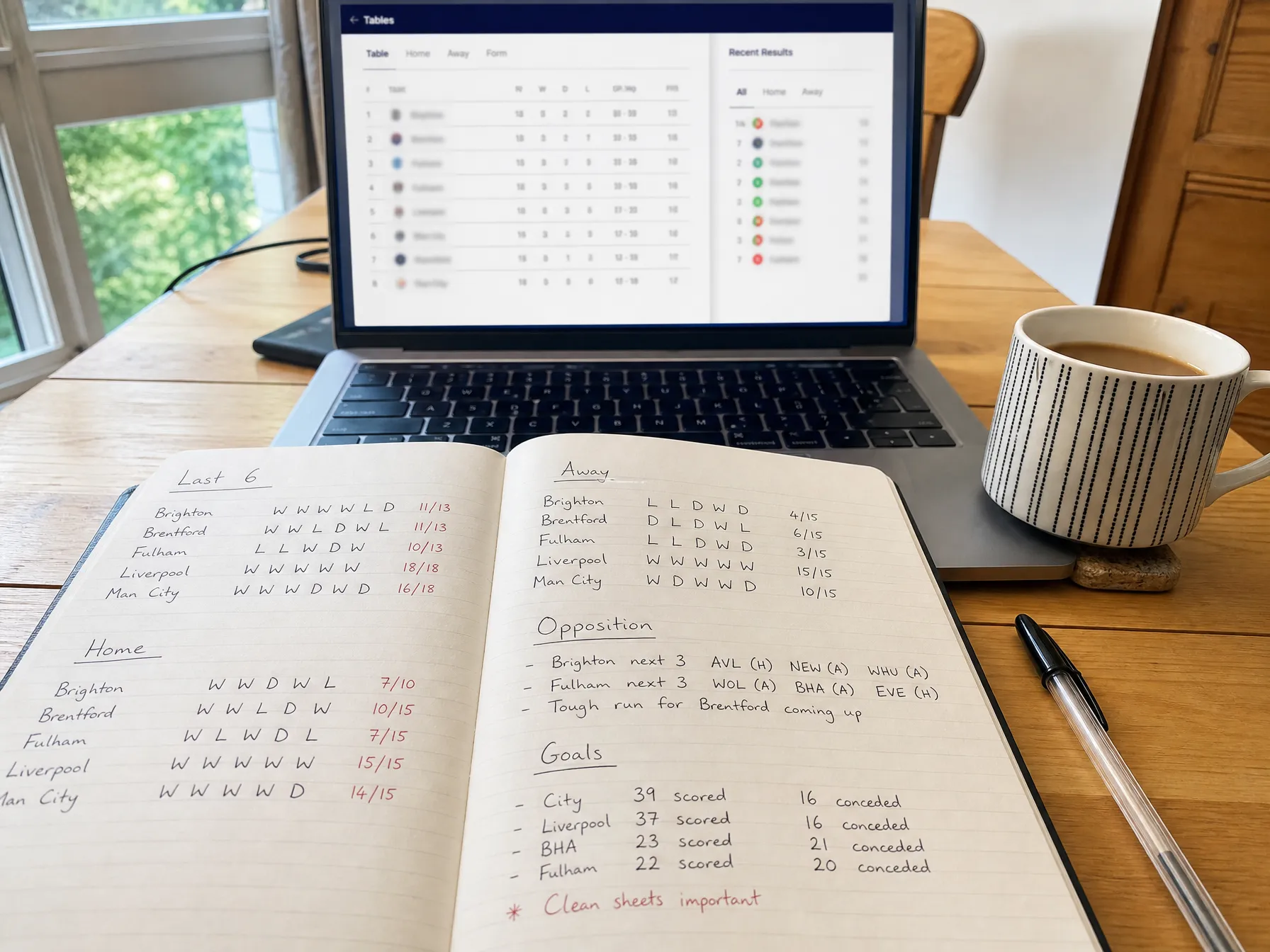
Who have they actually been playing?
This is one of my favourite questions. Because I think people sometimes look at a league table and forget that football isn't played against the league table. It's played against another team.
A side can have a brilliant-looking record that has been built against poor opposition. Another can have a terrible-looking record because they've just had a nightmare run of fixtures. Context matters.
If Bristol City lose three matches against three excellent teams, I'm not necessarily throwing myself off the nearest bridge. Although depending on the manner of the defeats, I might consider it.
The point is that results need context. I want to know who they've played. Where they've played them. How they've performed. And whether the underlying numbers support what the results are telling me.
Home and away form matters
Some teams are completely different at home. Others are strangely better away. There are sides who seem to thrive when they've got 30,000 people behind them. There are others who appear to regard home advantage as an inconvenience.
So I always separate home and away performance. If I'm looking at a home team, I want to know what they've actually been doing at home. Not just their overall league record. And if the away side has been dreadful on the road all season, that's relevant.
But again, I don't treat it as gospel. Football trends aren't laws of physics. A team that's lost eight consecutive away games can still win the ninth. That's the annoying bit.
If everything in football behaved exactly as the statistics predicted, we'd all be rich and there'd be no point watching the matches.
Then I check the team news
This is one of the things I take very seriously. A football team isn't just a name on a fixture list. It's eleven players, a manager, a tactical setup and a whole load of things that can change from week to week.
If a side is missing its first-choice striker, centre-back and goalkeeper, that's potentially significant. But injuries aren't automatically important just because a player is injured. If the backup is equally good, it might not matter much. If the missing player is the one who makes the entire system work, that's different.
And sometimes the biggest piece of news isn't an injury at all:
- A suspension
- A tactical change or a new manager
- A key player returning
- A congested fixture schedule
- European football three days earlier
- A cup match coming up that the manager might have one eye on
All of these things can affect how I view a game.
I look at the goals
This is where things start getting interesting. Goals are obviously important. It's football. You need to score more than the other bloke.
But I'm interested in how teams are scoring and conceding them. Some teams create loads of chances. Some score from very little. Some concede plenty but have a goalkeeper who keeps bailing them out. Some score regularly but rely heavily on set pieces.
Some matches produce loads of goals because both teams are genuinely creating chances. Others produce goals because someone has made a horrible mistake and the football gods fancied a laugh. Those aren't necessarily the same thing.
This is where statistics can help. Not replace watching football. Help.
Yes, I look at xG
Expected goals. You've probably heard of it. If you haven't, don't worry. We'll have a proper article about it, because I could spend all day talking about it and I've already promised my family I'm going to stop doing that at dinner.
The basic idea is that xG gives us a way of estimating the quality of chances a team creates and concedes. It's useful. Very useful, in fact. But I don't think it's magic.
If a team has scored ten goals from chances worth six expected goals, that might tell me something. If they've conceded three from chances worth nine expected goals, that tells me something too. But I'm not going to look at an xG number and decide the football match has already been played.
There are humans involved. Humans are unpredictable. I've met enough of them to know this.

Then I start thinking tactically
This is the bit I really enjoy. How are the two teams likely to approach each other? Where are the spaces?
Does one side press high? Does the other struggle against a press? Does one team defend narrow? Does the opposition have wingers who can exploit that? Does one side rely on crosses? Is the other team particularly vulnerable in the air? Are the full-backs getting forward? Who is likely to control midfield?
Sometimes you can look at two teams and immediately see a potential problem. A tactical mismatch. Something that could make one side much more effective than their overall record suggests.
And sometimes you look at it all and think: "I've got absolutely no idea." That's fine too.
Then I look at the odds
This is where the betting bit finally comes in. And you'll notice something. I've deliberately left it until quite late. That's because I don't want the odds influencing my initial opinion too much.
If I see a team priced at 2/1, it's very easy to think: "That looks big." But big compared to what? If I think they have a 30% chance of winning, 2/1 isn't particularly exciting. If I think they've got a 40% chance, that's a different story.
The price has to make sense relative to the probability. That's what I mean when I talk about value.
I'm not just trying to pick winners. I'm trying to find situations where I think the odds don't properly reflect the chance of something happening. That's a much harder job. It also means I'm going to be wrong. Quite regularly. That's betting.

Football writing, and free tips, every morning
Up to three researched selections at 8am with the reasoning behind them, plus pieces like this one. Free forever, and out again in one click.
By signing up you agree to receive the daily tips email. Unsubscribe in one click, any time.
Cheers
Check your inbox for the welcome email - if you can't find it, have a look in your spam folder.
Sometimes I don't like the bet
This is probably the least exciting part of being a tipster. But it's one of the most important.
Sometimes I analyse a match and don't like anything. The home team looks good. The away team looks good. The statistics are contradictory. The team news is unclear. The price isn't particularly attractive. And I think: no thanks. I'll move on.
There's no rule saying you have to bet on every match. You don't get extra points for finding a bet where there isn't one. I've had plenty of weekends where I've looked at fixture after fixture and thought, "Nope."
That's fine. There are hundreds of football matches being played every week. I don't need to have an opinion on every single one. And neither do you.
Get daily football tips for freeI try to separate football knowledge from football loyalty
This one has taken me years. Because I'm a Bristol City supporter. I love Bristol City. Which means, naturally, I am completely unbiased when it comes to Bristol City. Obviously. Ask anyone.
I'm perfectly capable of looking at City objectively. Unless we're playing. Then all bets are off.
But seriously, being a supporter can create some strange thinking. You know your own team's players. You've watched them more than most people. You understand the frustrations. You know when the manager is likely to make a certain change. But you can also become blind to things because you desperately want something to be true.
That's why I try to separate my football brain from my supporter brain. Sometimes they're not on speaking terms.
I also try not to fall in love with a bet
This is another dangerous habit. You spend an hour researching something. You find lots of evidence. Everything seems to line up. You start getting excited. Then you decide you've found the bet.
And once you've decided that, you start looking for evidence that agrees with you. That's confirmation bias. And it's bloody dangerous.
If I like a bet, I deliberately try to find reasons not to like it. What's the argument against it? What am I missing? What could go wrong? Is there something in the statistics that doesn't fit? Is the price actually good enough?
If I can't answer those questions, I'm not finished analysing.
Sometimes the best thing you can do is try to prove yourself wrong. If you can't, then perhaps you've found something. Perhaps. Don't get carried away. It's still football.
"Sometimes the best thing you can do is try to prove yourself wrong."
And then I make the decision
By this point, I've looked at:
- The teams
- Recent form
- Strength of opposition
- Home and away records
- Injuries and suspensions
- Goals and the underlying statistics
- xG
- Tactical matchups
- The betting market and the price
- The reasons the bet might lose
Then I make a decision. Sometimes it's a bet. Sometimes it isn't.
And if I do bet, I want to know exactly why. Not "I just fancy them." Not "they've won their last five." Not "it's a banker." I want something more substantial than that.
It might be that I think a team is being underrated. It might be that the matchup suits them. It might be that the goals market has been priced incorrectly. It might be that the numbers and the tactical picture are pointing in the same direction.
Whatever it is, I want to be able to explain it. Because if I can't explain why I like a bet, why would I expect anyone else to take it seriously?
The bit people don't like hearing
There is no perfect method. There isn't. Anyone who tells you otherwise is selling you something.
My process gives me a framework. It helps me make better decisions. It stops me betting purely because I have a feeling. It makes me think about the price. It makes me question my assumptions.
But it doesn't remove uncertainty. Nothing does. A football match can still go completely differently from what you expect.
That's why I don't want people reading my tips and blindly following them. I'd much rather you understood why I've picked something. Then you can decide whether you agree with me.
You might even spot something I've missed. If you do, tell me. I'll probably argue with you first. Then I'll go away and think about it. Then I'll probably admit you were right. Eventually.
So that's basically my process
It's not particularly glamorous. There are no secret rooms. No crystal balls. No algorithm called "TheoBot 3000". Although I've just written that down, so I might trademark it.
It's just football. Watch the matches. Understand the teams. Look at the numbers. Understand the context. Look at the price. Question yourself. And don't force a bet.
That's how I approach it. It won't guarantee winners. Nothing will. But I think it's a hell of a lot better than picking a team because you've got a feeling in your stomach and calling it analysis.
I've done that too. Usually after a few pints. It doesn't improve the accuracy.

And then the weekend gets involved
You can do all your analysis on Friday. Then Saturday morning comes.
A key player doesn't train. The manager gives an interview. The weather changes. The lineup drops and somebody you'd completely forgotten about is starting. Suddenly the whole thing looks different.
So I keep looking. I don't become emotionally attached to what I thought on Friday night. If new information changes my opinion, I'll change my opinion.
There's no prize for being stubborn. Well, except perhaps the respect of your mates. And I'm not sure that's worth much.
That's what I'm trying to do with the tips
When I put a free football tip out, that's the process behind it. I'm not claiming to know what's going to happen. I'm saying:
"I've looked at this match, I've considered the evidence, I've looked at the price, and I think this is worth a bet."
That's it. Sometimes I'll be right. Sometimes I'll be spectacularly wrong. That's the nature of the game.
But if you're going to follow along with me, at least you'll know how I arrived at the decision. And hopefully, even when a bet loses, you might still learn something useful from the reasoning behind it. That's much more valuable to me than pretending every selection is a guaranteed winner.
Right. That's enough football analysis for one sitting. I've got a match to watch.
And I've just realised I've spent an entire morning explaining how I analyse football matches when I could have simply been watching football. Which, when you think about it, is exactly how I ended up starting this blog in the first place.
See you next time.
Theo
Lifelong Bristol City supporter, ten years of trying to be a punter, and the writer of the free Daily Football Tips email. Publishes every selection, winners and losers alike, and recommends no bookmakers.